

Businesses involved in international disputes often face a procedural challenge: how to serve process on a foreign defendant and how long is it going to take?
A recent decision from Florida’s Third District Court of Appeal clarifies an increasingly important issue in international litigation: whether a plaintiff may serve a foreign defendant by email. In Wepard Corp., Ltd. v. Diaz, Reus & Targ, LLP (January 21, 2026), the court interpreted Florida’s foreign-service statute and concluded that email can be an authorized method of service when ordered by the court.
The Court’s Key Holding
The court rejected the argument that traditional methods of service must always be attempted first. Instead, the court explained:
“There is no hierarchy of service.”
Email service is simply one option among several methods available to serve an international defendant when approved by the court.
The Statutory Framework
Florida Statute §48.197(1)(c) allows courts to authorize service by alternative means, including email, if three conditions are met:
- The court authorizes the method
- The method is reasonably calculated to give actual notice
- The method is not prohibited by international agreement
This third requirement is where international treaties—particularly the Hague Service Convention—become relevant.
Why Email Service Matters
Serving a defendant overseas through traditional treaty procedures can take six months to a year or longer.
In contrast, email service may be appropriate when:
- the defendant conducts business online
- the defendant regularly communicates by email
- the email address is known and reliable
The decision reflects a broader trend in both state and federal courts recognizing that modern commerce frequently operates through digital communication.
How Different Countries Treat Email Service
Whether a court can authorize service of process by email often depends on how the destination country participates in the Hague Service Convention. Some countries permit alternative methods such as postal channels, while others have formally objected to them, which can affect whether courts will approve email service.
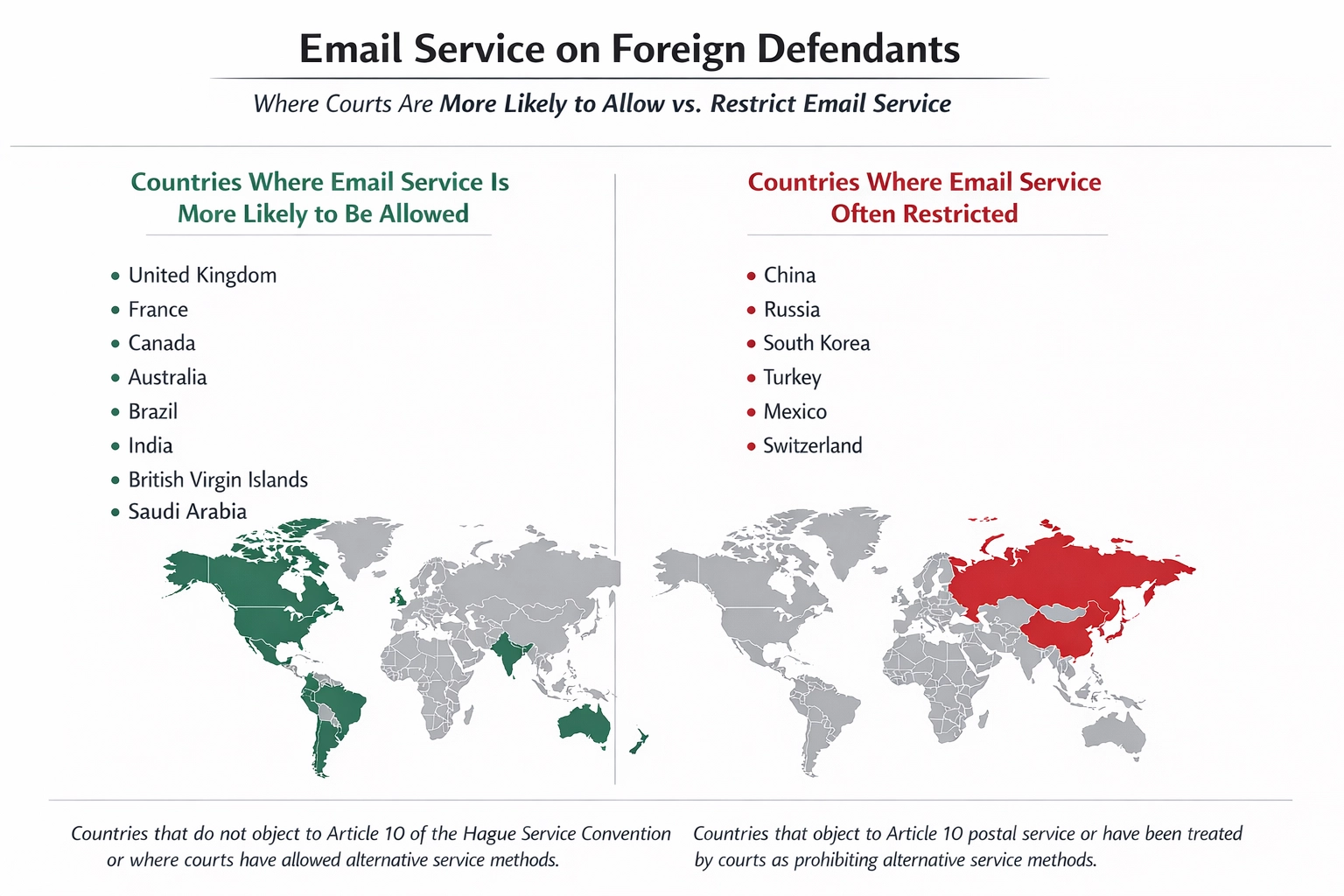
* Email service depends on court approval and treaty interpretation in each case.
When Email Service May Still Be Limited
The court emphasized that email service cannot be ordered if an international treaty expressly prohibits the method. In practice, this question most often arises under the Hague Service Convention, which governs service of judicial documents between many countries.
The Convention, however, was drafted in 1965—long before email existed. As a result, courts must determine whether the treaty’s silence about electronic service means email is prohibited or simply unregulated.
The next blog explains how that analysis works in practice, a more technical piece- When Email Service on Foreign Defendants Works — and When It Does Not